
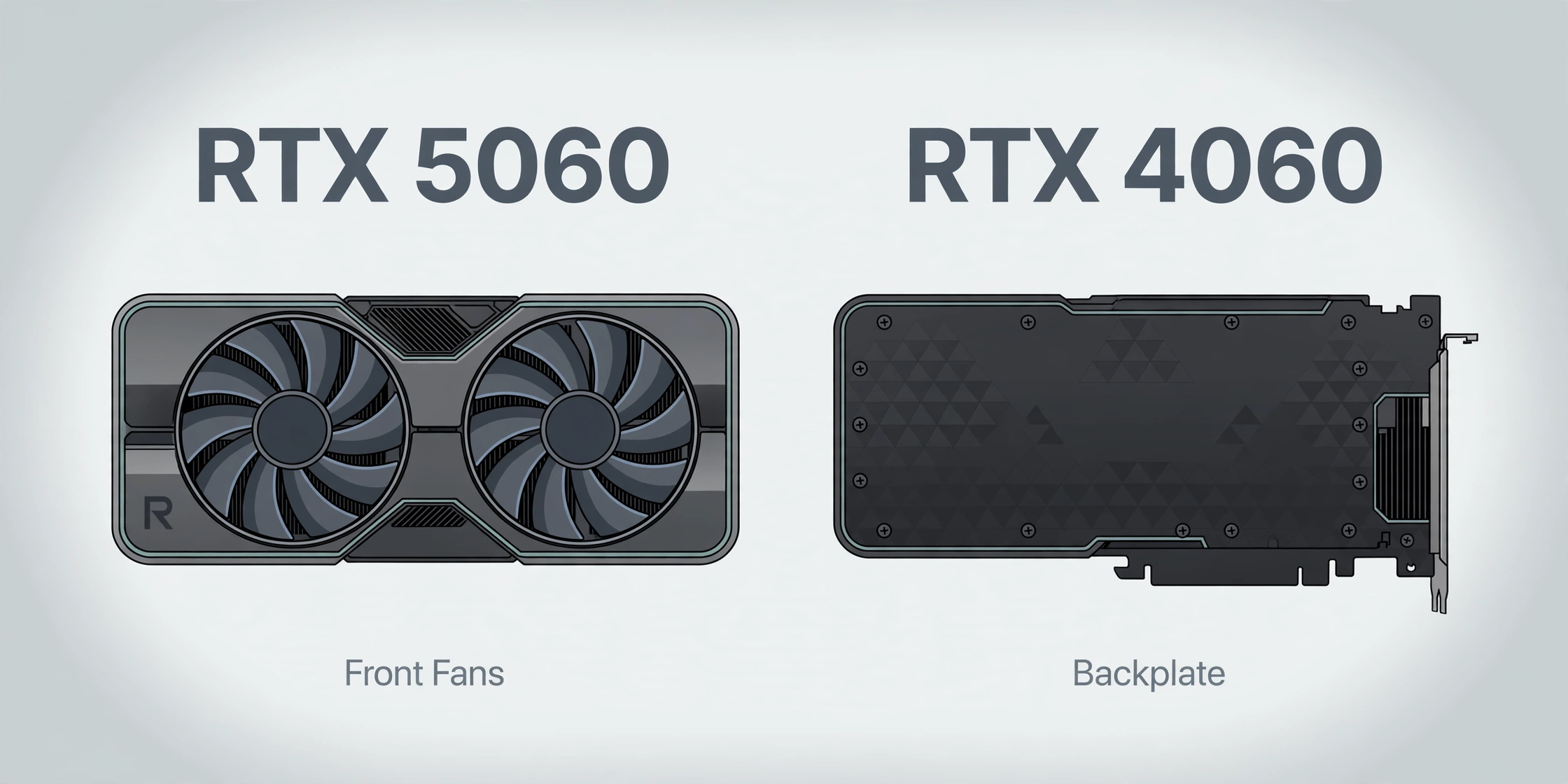

Quick Verdict
The RTX 5060 is the better card on paper and in most new games, thanks to its newer Blackwell architecture, faster GDDR7 memory and DLSS 4. But the upgrade is not a dramatic leap for everyone. If you already own an RTX 4060 and play at 1080p, the honest answer is usually to wait. If you are buying fresh, the RTX 5060 is the more sensible pick at a similar price point. The shared 8GB of VRAM is the one limitation both cards carry, and it matters more than the generation gap for some games.
Full Specs Table
| RTX 5060 | RTX 4060 | |
|---|---|---|
| Architecture | Blackwell (2025) | Ada Lovelace (2023) |
| VRAM | 8GB GDDR7 | 8GB GDDR6 |
| CUDA cores | 3,840 | 3,072 |
| DLSS generation | DLSS 4 | DLSS 3 |
| Launch MSRP (USA) | USD 299 | USD 299 |
| Boost clock | — | — |
| TDP | — | — |
| Ports | — (varies by partner card) | — (varies by partner card) |
Note: boost clock, TDP and port layouts are left as “—” here because they vary by partner card and were not verified for one single reference model. The core facts above — architecture, VRAM type, core counts and launch prices — are the widely reported headline specifications.
Design & Build
Both cards sit in the same mainstream class, and in practice most buyers will meet them as partner cards from brands such as ASUS, MSI, Gigabyte and others rather than as a single reference design. That means cooler size, fan count, length and looks vary from model to model. A typical dual-fan RTX 5060 or RTX 4060 fits comfortably in most mid-tower cases, but you should still check the exact length and slot thickness of the card you plan to buy against your own case.
The RTX 5060’s newer Blackwell design brings a more modern feature set, while the RTX 4060’s Ada Lovelace design is a known, mature quantity. Neither card is a showpiece flagship, and neither pretends to be. They are practical gaming cards built for real desks and real budgets, and that is exactly where they should be judged.
Performance: 1080p and 1440p Expectations
At 1080p, both cards are comfortable for the vast majority of modern games at high settings. The RTX 5060 has the edge thanks to its higher core count and much faster GDDR7 memory, so in newer titles it generally pulls ahead of the RTX 4060. How large that lead is depends heavily on the game, the settings and whether DLSS is in play — this comparison deliberately gives no single FPS number, because a single number would mislead more than it helps. A competitive shooter at modest settings behaves very differently from a demanding open-world game with ray tracing turned up, and results vary accordingly.
At 1440p, the picture is more mixed. The RTX 5060 handles 1440p well in many titles, especially with DLSS enabled, but this is where the shared 8GB VRAM ceiling starts to show. Games with very high-resolution textures can push against that limit, and when VRAM runs short, performance can become uneven regardless of which generation of card you own. The RTX 4060 faces the same ceiling, and at 1440p with demanding settings it is the weaker of the two.
For readers comparing individual cards in more depth, our full RTX 5060 review covers the newer card on its own, and the RTX 5060 Ti review shows what the next step up in the same family offers. If your budget stretches further, the RTX 5070 review is the natural next comparison point.
DLSS: The Real Generational Difference
DLSS is where the generation gap is clearest. The RTX 4060 supports DLSS 3, including frame generation, and that remains a genuinely useful feature for smoothing out demanding games. The RTX 5060 moves to DLSS 4, which adds Multi Frame Generation — the ability to generate multiple frames per rendered frame — alongside improved upscaling quality.
In practice, DLSS 4 frame generation can make a game feel much smoother, but it is not magic. It works best when the base frame rate is already reasonable, and it does not remove the VRAM limitation. It also depends on game support: not every title supports the newest DLSS features on day one. Still, for a buyer choosing today, DLSS 4 is a real reason to prefer the RTX 5060, because it is the feature set that future games will be built around.
The 8GB VRAM Question — Said Honestly
Both cards carry 8GB of video memory, and this deserves a plain, honest paragraph. At 1080p, 8GB remains workable for most current games, especially if you are willing to keep texture settings at high rather than ultra. At 1440p, and in the most texture-heavy new releases, 8GB is a genuine constraint that neither card escapes. Faster GDDR7 memory on the RTX 5060 helps move data more quickly, but it does not make 8GB into 12GB or 16GB.
If you plan to keep your card for several years and play the most demanding new releases at high settings, this is the strongest argument for looking above this price class altogether — for example at the RTX 5070 review — rather than agonising over 5060 versus 4060. If your gaming is mainly 1080p, or you upgrade every couple of generations, 8GB is a manageable compromise rather than a deal-breaker.
Power and Efficiency
Both cards are efficient by modern GPU standards, and both are realistic options for a mid-range PC with a sensible power supply. Exact power draw and recommended power supply ratings vary by partner model, so check the specification sheet of the exact card you buy rather than relying on a single generic figure. Neither card demands the kind of heavy power supply or cooling setup that high-end GPUs require, which is part of why this class is so popular for first-time builders and upgraders alike.
Pairing either card with a capable budget gaming laptop alternative is a different question — if a laptop suits you better, our HP Victus 15 review and Lenovo LOQ 15 review cover two popular gaming laptops in a similar value-first spirit.
Faide (Pros) — RTX 5060
- Newer Blackwell architecture with DLSS 4 support
- Faster GDDR7 memory and more CUDA cores than the RTX 4060
- Same USD 299 launch price class as its predecessor
- Better long-term feature support for upcoming games
Kamzoriyan (Cons) — RTX 5060
- Still limited to 8GB of VRAM
- Performance gains over the RTX 4060 vary a lot by game
- DLSS 4 frame generation needs game support to shine
Faide (Pros) — RTX 4060
- Mature, well-tested card with broad game support
- DLSS 3 frame generation still works well in supported titles
- Power-efficient and proven at 1080p
- Often cheaper on the street as a previous-generation model
Kamzoriyan (Cons) — RTX 4060
- Also limited to 8GB of VRAM
- Older architecture with an older DLSS generation
- Less future headroom than the RTX 5060
Price in Pakistan, India, UAE, USA, UK
| Country | RTX 5060 | RTX 4060 |
|---|---|---|
| Pakistan (PKR) | — | — |
| India (INR) | — | — |
| UAE (AED) | — | — |
| USA (USD) | 299 (launch MSRP) | 299 (launch MSRP) |
| UK (GBP) | — | — |
Price note: Pakistan prices are shown as “—” because street prices for graphics cards vary widely by shop, stock and import costs, and no single verified figure applies. The USA launch MSRP of USD 299 for both cards is the anchor point; always check current local pricing before buying, and remember that previous-generation cards like the RTX 4060 often sell below their launch price once a successor is out.
Kis Ke Liye Lena Chahiye, Kis Ke Liye Nahi
Buy the RTX 5060 if: you are buying a new card today, you want DLSS 4 and the newest feature support, and you mainly play at 1080p with some 1440p gaming.
Buy the RTX 4060 if: you find it at a clearly lower price than the RTX 5060, you mainly play at 1080p, and you are happy with DLSS 3.
Buy neither (yet) if: you already own an RTX 4060 and are happy at 1080p — the upgrade is real but modest, and waiting for a bigger jump will feel more rewarding. Likewise, if you mainly play very texture-heavy games at 1440p, consider saving for a card with more VRAM instead.
Final Verdict + Overall Rating
The RTX 5060 wins this comparison, but it wins on features and future-proofing more than on a dramatic performance leap. For a new buyer at a similar price, it is the right choice. For an RTX 4060 owner, it is a “wait” rather than a “must upgrade.”
★★★★☆ Our Rating: RTX 5060 7.5/10 | RTX 4060 7.2/10
FAQs
1. Is the RTX 5060 much faster than the RTX 4060?
It is faster in most new games thanks to more cores, GDDR7 memory and DLSS 4, but the size of the lead varies a lot by game and settings. It is an improvement, not a different class of card.
2. Is 8GB VRAM enough in 2026?
At 1080p, yes for most games, especially at high rather than ultra texture settings. At 1440p in the most demanding titles, 8GB can become a limitation on both cards.
3. Should I upgrade from an RTX 4060 to an RTX 5060?
Usually no, unless you specifically want DLSS 4 or you are moving to a higher refresh-rate display. The gain is real but modest for a one-generation jump at the same VRAM capacity.
4. Does the RTX 5060 support DLSS 4?
Yes. The RTX 5060 supports DLSS 4, including Multi Frame Generation in supported games, while the RTX 4060 supports DLSS 3.
5. Which card is better value?
At equal prices, the RTX 5060. If the RTX 4060 is clearly cheaper where you shop, it becomes the better value for 1080p gaming.