
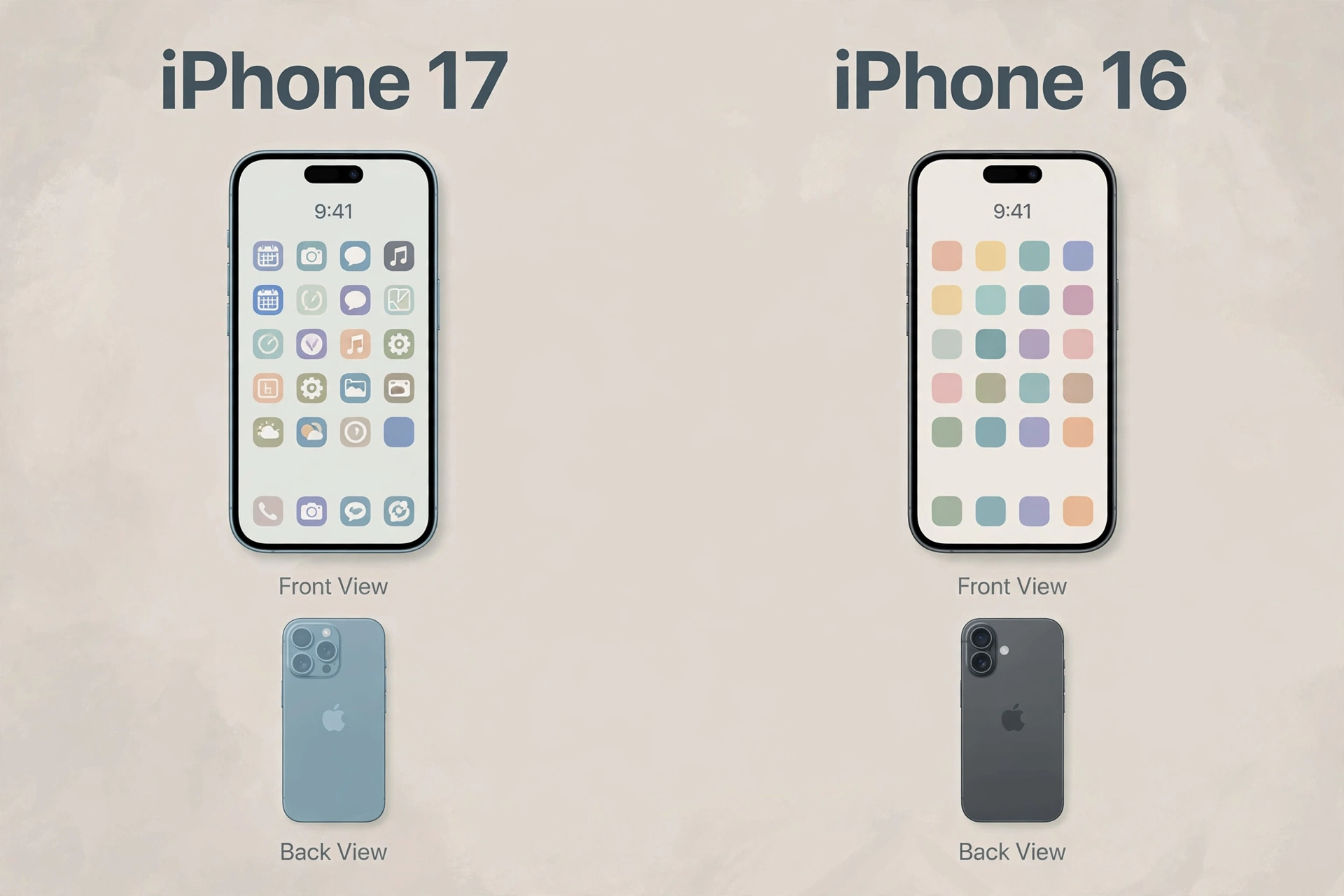

Quick Verdict
The iPhone 17 fixes the single biggest weakness of the base iPhone: its display. A larger, brighter 6.3-inch screen with a smooth 120Hz ProMotion refresh rate replaces the iPhone 16’s 60Hz panel, and the newer A19 chip plus a much better front camera complete a genuinely meaningful upgrade. But if you already own an iPhone 16, there is no rush — it remains a fast, capable phone with the same core camera quality and years of software support ahead. This comparison is for two groups: iPhone 16 owners wondering about switching, and buyers choosing between the two at today’s prices.
For the full individual verdicts, see the iPhone 17 review and, if you want the step above both of these, the iPhone 17 Pro Max review. Android buyers weighing the other side of the flagship market should also read the Samsung Galaxy S25 review.
Full Specs Table
| Specification | iPhone 17 | iPhone 16 |
|---|---|---|
| Launch | September 2025 | September 2024 |
| Display | 6.3-inch Super Retina XDR OLED, 2622 x 1206, ProMotion 120Hz adaptive (1–120Hz), up to 3,000 nits | 6.1-inch Super Retina XDR OLED, 2556 x 1179, 60Hz, up to 2,000 nits |
| Processor | Apple A19 | Apple A18 |
| RAM | Not officially published by Apple (—) | Not officially published by Apple (—) |
| Storage | 256GB / 512GB, no memory card slot | 128GB / 256GB / 512GB, no memory card slot |
| Rear Cameras | 48MP Fusion main + 48MP Fusion ultra-wide, macro support | 48MP Fusion main + 12MP ultra-wide, macro support |
| Front Camera | 18MP Center Stage camera | 12MP camera |
| Battery | Not officially published by Apple (—) | Not officially published by Apple (—) |
| Charging | Fast charging via USB-C, MagSafe wireless charging | Fast charging via USB-C, MagSafe wireless charging |
| Operating System | iOS 26 at launch | iOS 18 at launch (upgradable) |
| Connectivity | USB-C, 5G, Wi-Fi 7, Bluetooth, MagSafe | USB-C, 5G, Wi-Fi 7, Bluetooth, MagSafe |
Note on the “—” entries: Apple does not officially publish RAM figures or battery capacities for iPhones, so those values are deliberately left blank rather than guessed from teardowns. Real-world battery life is discussed below instead, because that is what actually matters to a buyer.
Design & Build
Put the two phones side by side and most people will struggle to tell them apart at a glance. Both use the familiar flat-edge aluminium frame, glass back, vertical dual-camera module and USB-C port, and both feel like premium, carefully assembled devices. The iPhone 17 is slightly larger and a touch heavier because of its bigger screen, but the difference in the hand is small — neither phone is hard to use one-handed, and both fit comfortably in a pocket.
The iPhone 17’s display has slimmer bezels, which is part of why the screen feels more modern, and its brighter panel is the more useful change in daily life.
Display / Screen
This is where the upgrade is most obvious, and it is the single best reason to choose the iPhone 17. The jump from 60Hz to an adaptive 120Hz ProMotion display changes how the phone feels every minute you use it: scrolling is smoother, animations are more fluid, and the screen can drop to very low refresh rates when nothing is moving, which helps battery life. Add a larger 6.3-inch panel and a much higher peak outdoor brightness of up to 3,000 nits, and the iPhone 17’s screen is simply in a different class — easier to read in harsh sunlight, better for video, and more pleasant for everything else.
The iPhone 16’s display is not bad. It is a sharp, colour-accurate OLED that is perfectly fine for video, reading and social media, and many users coming from older phones will be happy with it.
Performance
The A19 in the iPhone 17 is a generation newer than the A18 in the iPhone 16, and in practice both chips are far faster than most people need. Everyday tasks — messaging, browsing, photography, social apps — feel instant on either phone, and both handle demanding games and video editing without breaking a sweat. The A19’s advantage is about longevity rather than today’s speed: it gives the iPhone 17 more headroom for future iOS versions, heavier apps and on-device AI features over a four- or five-year ownership period.
For iPhone 16 owners, this is the key reassurance: the A18 is not slow, and it will not feel slow next year either.
Camera
Both phones share the same excellent 48MP Fusion main camera, so daylight photos from either phone look superb: sharp, natural colours, and strong dynamic range. The differences sit around that main sensor. The iPhone 17 upgrades the ultra-wide camera to 48MP, which means wider shots carry more detail and macro photos look better, while the iPhone 16’s 12MP ultra-wide is good but a clear step behind in resolution.
The front camera is the other real upgrade. The iPhone 17’s 18MP Center Stage camera captures wider, more detailed selfies and can automatically adjust framing for group shots, which is genuinely useful for video calls and group photos. The iPhone 16’s 12MP front camera is still fine for selfies and calls, but it lacks that flexibility. Neither phone has a dedicated telephoto lens, so long-range zoom on both is digital — if zoom photography matters to you, a Pro model is the honest recommendation. For buyers comparing camera-first phones across brands, the Samsung Galaxy S25 review shows what a dedicated 3x optical zoom adds.
Battery / Power
Apple does not publish battery capacities, so this section judges real-world endurance rather than milliamp-hour numbers. Both phones comfortably last a full day of normal use — messaging, browsing, some video and photography — and both support fast charging over USB-C plus MagSafe wireless charging. The iPhone 17 has a small edge: its newer, more efficient A19 chip and adaptive 1–120Hz display help it stretch a charge a little further under mixed use, and its brighter screen does not cost as much battery as the raw brightness figure might suggest.
Heavy users should expect to charge either phone every night, and neither phone is a two-day battery champion. If battery life is your top priority, a larger Pro Max model is the better buy — see the iPhone 17 Pro Max review. One practical note for both phones: neither includes a charger in the box, so budget for a USB-C charger if you do not already own one.
Pros
iPhone 17: 120Hz ProMotion display with always-on; larger, much brighter 6.3-inch screen; A19 chip with years of headroom; better front and ultra-wide cameras; 256GB base storage.
iPhone 16: Still fast and smooth with the A18 chip; excellent 48MP main camera; now usually cheaper than the iPhone 17; same premium build and long software support.
Cons
iPhone 17: No dedicated telephoto camera; no charger in the box; design barely changed from the iPhone 16; battery capacity not officially published.
iPhone 16: 60Hz display feels dated; smaller, dimmer screen; older 12MP front camera; 128GB base storage can feel tight for heavy photo and video users.
Price in Pakistan, India, UAE, USA, UK
| Country | iPhone 17 | iPhone 16 |
|---|---|---|
| Pakistan (PKR) | — | — |
| India (INR) | — | — |
| UAE (AED) | — | — |
| USA (USD) | — | — |
| UK (GBP) | — | — |
Price note: exact prices are deliberately left as “—” because launch prices, taxes, import duties and street prices vary widely by market, storage size and time, and the iPhone 16’s price has moved since launch. As a rule of thumb, the iPhone 16 now sells for noticeably less than the iPhone 17 in most markets, and that gap is the main argument for choosing it. Always check a current local listing before buying, and compare the same storage size on both phones — the iPhone 17 starts at 256GB, while the iPhone 16 starts at 128GB, so a like-for-like comparison should use the 256GB iPhone 16.
Who Should Buy, Who Should Skip
Buy the iPhone 17 if: you are upgrading from an older iPhone (14 or earlier), you want the smoothest display Apple offers on a base iPhone, you take a lot of selfies or group photos, or you plan to keep the phone for four or more years. The 120Hz screen and A19 chip make it the better long-term buy.
Buy the iPhone 16 if: you already own one (keep it), you find it at a clearly lower price than the iPhone 17, or you simply do not care about refresh rates and want a proven, fast iPhone for less money. It is still a very good phone — it is just no longer the best value at full price.
Buy neither if: you need a telephoto zoom camera, maximum battery life, or the fastest possible performance — in that case a Pro model is the honest step up, starting with the iPhone 17 Pro Max review.
Final Verdict
The iPhone 17 is the better phone, and the display upgrade alone makes it the right choice for most new buyers. But the iPhone 16 is not obsolete — it remains fast, well-built and well-supported, and at a discount it is arguably the smarter buy. iPhone 16 owners should skip this generation unless the 120Hz screen matters enough to them to justify the switch; everyone else buying fresh should get the iPhone 17.
★★★★☆ Our Rating: iPhone 17 9.0/10, iPhone 16 8.4/10
Per-category ratings — iPhone 17: Design 8.8 / Performance 9.2 / Display 9.4 / Camera 9.0 / Battery 8.6 / Value 8.8. iPhone 16: Design 8.7 / Performance 8.8 / Display 7.6 / Camera 8.5 / Battery 8.4 / Value 8.4.
FAQs
Is the iPhone 17 worth upgrading from the iPhone 16?
For most iPhone 16 owners, no — the upgrade is mainly the 120Hz display, a newer chip and better cameras, and the iPhone 16 is still fast and well-supported. Upgrade if the smoother display matters a lot to you, or if you are coming from an older iPhone.
What is the biggest difference between the iPhone 17 and iPhone 16?
The display. The iPhone 17 has a larger, brighter 6.3-inch 120Hz ProMotion screen, while the iPhone 16 has a 6.1-inch 60Hz screen. That difference is visible every time you use the phone.
Do both phones have USB-C?
Yes. Both the iPhone 17 and iPhone 16 use USB-C for charging and data, and both support MagSafe wireless charging.
Which phone has the better camera?
The iPhone 17, mainly for its 48MP ultra-wide camera and 18MP Center Stage front camera. The main 48MP camera is excellent on both phones, and neither has a dedicated telephoto lens.
How long will the iPhone 16 keep getting updates?
Apple typically supports iPhones with major iOS updates for many years after launch, so an iPhone 16 bought today should receive updates for several more years. The iPhone 17, being a year newer, will naturally be supported for about a year longer.
Related
If you are still deciding, read the full iPhone 17 review and the iPhone 17 Pro Max review for the step-up option. Android alternatives worth comparing are the Samsung Galaxy S25 review and the Samsung Galaxy A56 review, and budget buyers should check the best mobiles under Rs. 50,000 in Pakistan guide.